Monday, 17 June 2013

Game Console Timeline


                                                                                 Magnavox Odyssey


This was the first home console produced, it was made in 1972 by Magnavox and was considered successful . The console was designed by Ralph Baer, he began work on the console in 1966 and in 1968 had a fully working prototype, this was known as "The Brown Box". The console was discontinued in 1975.
It was played using a Control Paddle, the console came with two of these for multi-player games, and also was the first console to have an add-on peripheral; the first commercial light gun called the Shooting Gallery.

Atari 2600

This was a home console developed by Atari and produced in 1997, it  sold a total of 30 million units and was then discontinued in 1992.
It was played using a Joystick or a Paddle depending on what game was being played. It was also credited with popularizing the use of microprocessor-based hardware and cartridges containing game codes, on release you could buy 8 games different interchangeable cartridges.


Nintendo Entertainment System (NES)
The NES was first released on July 15th 1983 and sold a total of 61.91 million units, it was played using two controller ports and also has an expansion slot. The best selling game for the console was Super Mario Bros. 3 which sold approximatley 40 million units. The console was released with 18 launch titles, including Donkey Kong Jr. and Duck Hunt, these games were highly Favorited by fans of the NES.


Sega Genesis (Mega Drive)
File:Sega-Genesis-Mod2-Set.jpgThe Genesis, also known as the Mega Drive, was one of the most popular fourth-generation consoles; made by Sega, it sold approximately 40 million units and it's most popular game was Sonic the Hedgehog which was sold with the console.
After Sony designed the popular CD Sega felt they should also be a part of this ever expanding technology craze, and so they designed an add-on for the Mega Drive which was a CD/ROM drive, this allowed owners to play CD based media, including Games and Audio.


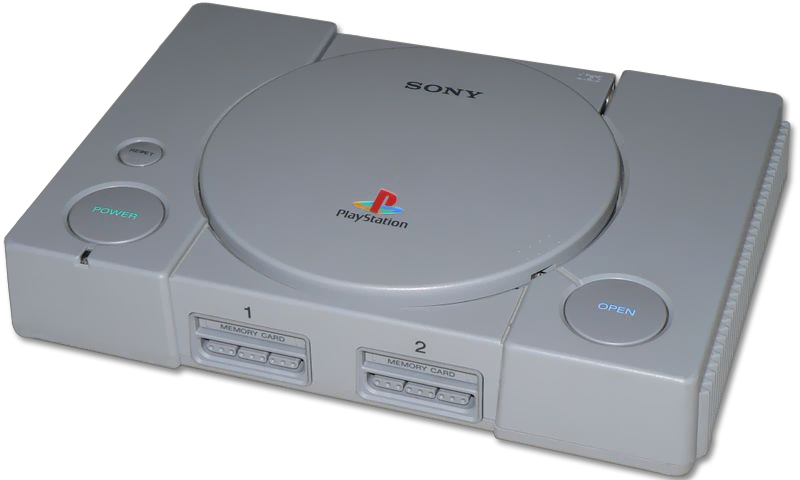
Sony PlayStation

The Sony PlayStation is one of the most revolutionary consoles to have ever been released, the console has sold over 150 million units. The console was played using a Game Pad, the console had 2 controller ports to play multi-player games, it was also one of the first consoles to incorporate a memory card as a means of saving game data. The console used CD's to play games and was also capable of playing Audio CD's. The console had many best sellers that are still remembered today and whose franchises are still expanding. Sony also released later on the Sony Duel Shock Analog controller, which had 2 analog sticks on the pad to give players full 360 degree rotation. This increased the consoles popularity further as people found it much easier to play.


Microsoft Xbox


The Xbox was released in America in 2001 and was the first console to be manufactured by Microsoft, joining the gaming band-wagon a little later than other companies (sixth-generation) Microsoft had to compete with Sony's Playstation 2 and Sega's Dreamcast. Amazingly enough the company sold more than 25 million  units (as of 2008) and had a massive fanbase. The console used a Dual analog game bad which also had a standard D-pad, Shoulder Triggers, A B X Y Face Buttons and the consoles own "Black and White Buttons". On the Xbox up to 4 people could play local split screen which boosted its popularity further. What made Xbox so popular was in addition to its revolutionary graphics and brilliant launch titles was Xbox Live, which was introduced the upcoming November. Players loved this service as many people found it superior to Sony's online Playstation service the only downside being you had to pay for it. The best selling game for the Xbox to date is Halo 2, which grew onto the Xbox 360 and now Halo is Microsofts most popular game series and is recognized globally. It was so popular because players said it was the best online game out there. The console was also the first to use a Hard Drive to save data.


Wednesday, 5 June 2013

RAM


RAM stands for Random Access Memory. Random Access Memory provides space for a computer to read and write data to be accessed by the CPU (central processing unit). When  refering to a computer's memory, it usually mean its RAM.

when adding more RAM to a computer, this would reduce the number of times the CPU must read data from the hard disk.


This usually allows a computer to work considerably faster, as RAM is many times faster than a hard disk. RAM is volatile, so data stored in RAM stays there only as long as a computer is running. As soon as the computer is turned off, the data stored in RAM disappears. When the computer is turned back on again, the computer's uses instructions stored semi-permanently in the ROM chip.


RAM is needed in a game platform to enhance the player's experience of the platform itself. For example It is needed so that the game does notv jerk frequently. If there was no RAM in a console it would cause it run incredibly slow and wouldn't make it in the market.

Tuesday, 4 June 2013

GPU

GPU:

A graphics processing unit (GPU) is a specialized electronic circuit designed to rapidly manipulate and alter memory to accelerate the creation of images in a frame buffer intended for output to a display.

GPU in a phone:

This is a GPU located on the motherboard
of a mobile device.


GPU in a computer:

This is a GPU which can be located inside a compuer.
Due to the size difference, the computer GPU has the
capability to much stronger.


GPU in a games console:


This is a GPU located inside a Play Station 3.


The CPU is a general purposepeice of hardware, often refered to as the brain of a PC. The GPU is specialised for graphics. This means that the GPU is optimised to process trigonometry type processes, this means that they process the triangles in any object displayed on a screen.
CPUs on the other hand are optimised to process more general math for processes overall.

Although CPUs and GPUs are very different they do have a key similarity which is that both peices of hardware, they're both connected to the circuit board that process arthimical and output operations, they both also use "cores" to do any task they undertake.

There are several different API used to communicate with GPU, the main ones are DirectX and VideoToolBox. DirectX is used by Microsoft for Windows on PCs and on the Xbox 360. VideoToolBox is used by Apple for the MAC OS and Apple TV.

A GPU goes through a variety of intense computations to display 3d graphics, this is usualy known a a graphics pipeline. There are various steps of the Grphics Pipeline before the final image can be displayed on screen.

Steps of the Graphics Pipeline:


Per-vertex lighting and shading:

Geometry in a 3D scene is lit according to the different locations of light sources.
Some, (Mostly older) hardware implementations of the Graphics Timeline compute lighting only at the vertices of the polygons being render. The different lighting values of vertices  are then interpolated during the rasterization process.

Clipping:
Geometric primitives that now fall completely outside of the viewing frustum will not be visible and are discarded at this stage to increase work speed and decrease chance of loss of frame rate.

Projection transformation:
In the case of a Perspective projection, objects which are distant from the camera are made smaller. This is achieved by dividing the X and Y coordinates of each vertex of each primitive by its Z coordinate(which represents its distance from the camera).

Viewport transformation:
The post-clip vertices are transformed once again to be in window space. In practice, this transform is very simple: applying a scale (multiplying by the width of the window) and a bias (adding to the offset from the screen origin). At this point, the vertices have coordinates which directly relate to pixels in a raster.

Scan conversion and rasterization:
Rasterization is the process by which the 2D image space representation of the scene is converted into raster format and the correct resulting pixel values are determined. From now on, operations will be carried out on each single pixel. This stage is rather complex, involving multiple steps often referred as a group under the name of pixel pipeline.

Texturing and fragment shading:
At this stage of the pipeline individual fragments (or pre-pixels) are assigned a color based on values interpolated from the vertices during rasterization, from a texture in memory, or from a shader program.

Display:

The final colored pixels can then be displayed on a computer monitor or other display.


Tuesday, 12 February 2013

CPU

CPU

The term CPU is used when talking about computers stands for "Central Processing Unit".
Central Processing Unit is the hardware within a computer system or smartphone which carries out the instructions of a computer program. The operations consist of, basic arithmetical, logical, and input/output operations of the system.
The CPU would be located underneath a fan
Similar to this on any computer.

The CPU is located on the motherboard inside the computer tower. The CPU is located under the heat sink that nearly always has a fan on top of it.


The CPU sits in the motherboard as the central unit. All of the other hardware components and programs installed on the system must go through the CPU before their function can be carried out. The CPU's job function is important and enormous in scale.
When a function, program or piece of data is called, the CPU pulls it from Random Access Memory (RAM) and any other hardware in order to process it. The CPU then reads the instructions associated to the task before sending it back to RAM. The instructions that the CPU receives pertains to calculations and data transportation. The system bus is the trail that the data must travel before it is executed. It is the CPU's job to make sure that the data is guided through the system bus to be processed by the CPU and then on to the next step. With every stop on the system bus, the CPU makes sure that the data gets there in the correct order.

Often known as CPU power, CPU cycles, and various other names, processing power is the ability of a computer to manipulate data. Processing power varies with the architecture (and clock speed) of the CPU. Usually CPUs with higher clock speeds and those supporting larger word sizes have more processing power than slower CPUs supporting smaller word sizes.
A fact about CPU's is that their processing power is fixed, this means that the CPU you can only run so fast before it begins to overheat. and another being that their processing power cannot be stored for later use. In other words, if a CPU can process 100 million instructions in one second, one second of idle time equals 100 million instructions worth of processing that have been wasted.

The reason that the power of a CPU is crucial in a gaming platform is so that the developers know how fast a game can run and how much a console can withstand. the developers wouldn't want their games to be jerky/laggy, they would want a clean, crisp frame rate.


Examples of processors used in the PSONE and the PS3:

PSONE:
R3000A 32bit RISC chip @ 33.8mhz

PS3:
3.2 GHz Power Architecture-based PPE with eight 3.2 GHz SPE

**Describe the PROCESSING CAPABILITIES**


More modern CPU's are known to have what is called "multiple cores". For example an 8-core processor, this means that the CPU has 8 cores, which also gives the CPU the capability to be 8 times better than it would be if it was a single core. The CPU will be given a speed that it can be run at, for example, 3.8 GHz, it won't be able to run any faster than 3.8 GHz but it can split the work load of doing multiple tasks on a computer to optimize the run speed.


Tuesday, 9 October 2012

UNIT 20: Hand Held Gaming Devices


A handheld game console is a portable game console that has it's own built-in screen, game controls, speakers and replaceable and/or rechargeable batteries or battery pack.


The very first handheld, digital video game console was the Mattel Auto Race. This was released in 1977 and was the first of many Mattel Electronics games. Mattel Auto Race was a built in game, so on it's release, there were no other games available for hand held use. The Mattel Auto Race waas not very popular, but shortly after it's release the game, Mattel Football was released and this was highly successful.


In 1979 the Microvision was released by the Milton Bradley Company. It was the first ever hand held console to be released that had interchangable cartridges. This was very popular in the first year of it's release, but in 1981 was lead to it's demise aloong with the entirity of handheld gaming due to home consoles.


On April 21st 1989, handheld gaming was revived by Nintendo with the release of the Gameboy. The Gameboy had interchangable cartridges and was run on AA-batterys that could last up to 35 hours if they were of a high power and a good brand. The gaboy had a Dightial operation system and had a multiplayer option available if you purchased a link cable.The Gameboy  The Game Boy also contains optional input and/or output connectors. On the left side of the system is an external power supply jack that allows users to use an external rechargeable battery pack or AC adapter instead of four AA batteries.The Game Boy requires 6 V DC of at least 150. A 3.5 mm stereo headphonejack is located on the bottom side of the console which allows users to listen to the audio with headphones or speakers. Some of the reasons why this


Nokia released snake on a mobile device which was a  monochrome phones game. The graphics consisted of black squares, and it had 4 directions. It was programmed in 1997 by Taneli Armanto, a design engineer in Nokia and introduced on the Nokia 6110n


 Nintendo's Gameboys successor the Game Boy Colour and was released on October 21, 1998. The processor is twice as fast as a Game Boy's and has twice as much memory. It also had an infrared communications port for wireless linking. The resulting product was backward compatible, a first for a handheld console system, and leveraged the large library of games and great installed base of the predecessor system. The console was capable of displaying up to 56 different colors simultaneously on screen from its palette of 32,768, and could add basic four-color shading to games that had been developed for the original Game Boy. It could also give the sprites and backgrounds separate colors, for a total of more than four colors.


The Nintendo DS, is a dual screen handheld game console developed and released by Nintendo. It was released on November 21, 2004. The DS, short for dual screen introduced new features to handheld gaming: an LCD screen working in tandem with a touchscreen, a built-in microphone, and support for wireless connectivity.Both screens are encompassed within a clamshell design. The Nintendo DS also features the ability for multiple DS consoles to directly interact with each other over Wi-Fi within a short range without the need to connect to an existing wireless network. Alternatively, they can interact online using the Nintendo Wi-Fi Connection service.


The PlayStation Portable is a handheld game console manufactured and marketed by Sony Corporation. DThe system was released in Japan on December 12, 2004
The PlayStation Portable is the only handheld video game console to use an optical disc format, Universal Media Disc (UMD), as its primary storage medium. Other distinguishing features of the console include its large viewing screen, robust multi-media capabilities, and connectivity with the PlayStation 2, PlayStation 3, other PSPs and the Internet.


The Nintendo 3DS is a portable game console produced by Nintendo. The device is able toproject 3D effects without the use of 3D glasses oThe Nintendo 3DS features backward compatibility with Nintendo DS series software, including Nintendo DSi software. The console succeeds the Nintendo DS series of handheld systems.The Nintendo 3DS has three cameras: a single camera on the front/inside of the system that cancapture standard 2D images and two rear facing cameras on the back of the system which can be used together to capture 3D images. These photos can be edited with various effects.The outer camera and inner camera have an ability to zoom. The cameras can shoot pictures up to 0.3 mp.


The PlayStation Vita is a handheld game console manufactured and marketed by Sony ComputerEntertainment. It is the successor to the PlayStation Portable as part of the PlayStationbrand of gaming devices.The handheld includes two analog sticks, a 5-inch multi-touch touchscreen, and supports Bluetooth, Wi-Fi and 3G.


Monday, 1 October 2012

The timeline of gameing for Personal computers:


The first Personal Computer available for playing games was the Comodore Pet:

The Commodore PET (Personal Electronic Transactor) was the first personal computers and was released in 1977. the Commodore Pet came fully assembled and was pretty straight forward. It came with either 4 or 8 kilobytes of memory, 2 built in cassette drives and a membrane chiclet keyboard.


This is an image of the Commodore PET.


The next step in the Gameing Personal Compter was the Apple II:


The Apple II because extremely well known extremely fast. It was released in 1977 with is own printed circuit board, switching power supply, keyboard and game paddles. the computer would also come with a cassette tape containing the game, Breakout. When the Apple II was hooked up to a colourd television screen, people at the time thouhgt that it was brilliant colour graphics.


The Apple II.


_____


Atari introduces the Model 400 and 800 Computer. Shortly after delivery of the Atari VCS game console, Atari designed two microcomputers with game capabilities: the Model 400 and Model 800. The two machines were built with the idea that the 400 would serve primarily as a game console while the 800 would be more of a home computer. Both sold well, though they had technical and marketing problems, and faced strong competition from the Apple II, Commodore PET, and TRS-80 computers

+

Atari released the Model 400 and 800 computer


Atari 400


Atari 800


___


Commodore introduces the Commodore 64. The C64, as it was better known, sold for $595, came with 64KB of RAM and featured impressive graphics. Thousands of software titles were released over the lifespan of the C64. By the time the C64 was discontinued in 1993, it had sold more than 22 million units and is recognized by the 2006 Guinness Book of World Records as the greatest selling single computer model of all time.

Commodore 64


____


Apple Computer launched the Macintosh, the first successful mouse-driven computer with a graphic user interface, with a single $1.5 million commercial during the 1984 Super Bowl. Based on the Motorola 68000 microprocessor, the Macintosh included many of the Lisa´s features at a much more affordable price: $2,500.

Apple´s commercial played on the theme of George Orwell´s "1984" and featured the destruction of Big Brother with the power of personal computing found in a Macintosh. Applications that came as part of the package included MacPaint, which made use of the mouse, and MacWrite, which demonstrated WYSIWYG (What You See Is What You Get) word processing.


The Apple Macintosh


____


IBM introduced its PS/2 machines, which made the 3 1/2-inch floppy disk drive and video graphics array standard for IBM computers. The first IBMs to include Intel´s 80386 chip, the company had shipped more than 1 million units by the end of the year. IBM released a new operating system, OS/2, at the same time, allowing the use of a mouse with IBMs for the first time.
The IBM Personal System 2


____


Apple cofounder Steve Jobs, who left Apple to form his own company, unveiled the NeXT. The computer he created failed but was recognized as an important innovation. At a base price of $6,500, the NeXT ran too slowly to be popular.

The significance of the NeXT rested in its place as the first personal computer to incorporate a drive for an optical storage disk, a built-in digital signal processor that allowed voice recognition, and object-oriented languages to simplify programming. The NeXT offered Motorola 68030 microprocessors, 8 megabytes of RAM, and a 256-megabyte read/write optical disk storage.


The NeXT computer

Unit 20: Computer Game Platforms and Technologies


The introduction of gaming all started back in the early 70's with strangely enough, a oscilloscope. A man named William Higinbotham created a game on the oscilloscope called "Tennis for Two" which is a two dimensional representation of a tennis court which then appeared on the oscilloscope screen. This game was then said to become extremely popular and started the revolution of gaming.


The next big thing that was created was the Arcade Machine. This was originally created with a television screen inside a cabinet with extremely primitive games that were started by inserting the amount of coins that were asked to be inserted.


The Arcade Machine first appeared in 1971 when students from Stanford University set up an arcade game called, Galaxy Game. Galaxy Game was the very first commercial video game. It was installed in Tresidder Union in September 1971, the game was quickly acknowledged by the Stanford community, with people waiting for up to hours for a turn of this machine. The typical features of an arcade game consisted of a monitor, on which the game is displayed. They may display either raster or vector graphics, raster being most common. Standard resolution is between 262.5 and 315 vertical lines, depending on the refresh rate (usually between 50 and 60 Hz). Slower refresh rates allow for better vertical resolution. Monitors may be oriented horizontally or vertically, depending on the game. Some games use more than one monitor. Some newer cabinets have monitors that can display high-definition video. They also featured printed circuit boards (PCB) or arcade system boards, the actual hardware upon which the game runs. Hidden within the cabinet. Some systems, such as the SNK Neo-Geo MVS, use a main board with game carts. Some main boards may hold multiple game carts as well.


A power supply to provide DC power to the arcade system boards and low voltage lighting for the coin slots and lighted buttons.
Some of the features available on the
original arcade machine. 

A marquee, a sign above the monitor displaying the game's title. They are often brightly colored and backlit.

A bezel, which is the border around the monitor. It may contain instructions or artwork.

A control panel, a level surface near the monitor, upon which the game's controls are arranged. Control panels sometimes have playing instructions. Players often pile their coins or tokens on the control panels of upright and cocktail cabinets.

Coin slots, coin returns and the coin box, which allow for the exchange of money or tokens. They are usually below the control panel. Very often, translucent red plastic buttons are placed in between the coin return and the coin slot. When they are pressed, a coin or token that has become jammed in the coin mechanism is returned to the player. See coin acceptor. Early coin slots could be defeated using a piezo-electric gas fire or gas oven igniter held against the steel bodywork of the cabinet, thus enabling free credits to be obtained. In some arcades, the coin slot is replaced with a card reader that reads data from a game card bought from the arcade operator.
The sides of the arcade cabinet are usually decorated with brightly coloured stickers or paint, representing the gameplay of their particular game.


After this very large companies realized that they could make a lot of money making Arcade Machines, so they began to make their own Arcade Machines using their own game ideas.
In 1972 the company named Atari was formed by Nolan Bushnel and Ted Dabney, who were originally an engineering firm called Syzygy Engineering. Atari essentially created the Coin-Operated video game industry with the video game named, Pong. The very first electronic Ping Pong video game. Imitators stopped Atari from dominating the entire video game market by recreating the pong Arcade Machine using different sprites and giving it a different name.


Atari are mostly responsible for a lot of the progress made in the gaming world. A lot of the games that they released inspired a chain of events that took gaming to the level that is is today. The games that inspired people the most were, Pong, Space invaders and Centipede.

 After this chain-reaction the popularity of Arcade Machines went through the roof, they were being sold to. bars, pubs and even some restaurants.

Although the Arcade Machine was popular, it had many limitations and flaws that some people may have not cared about back then. An example of the main limitation being the most obvious thing about it being that you had to go to it and spend money every time you wanted to play it. People back then wouldn't have cared because they didn't have Home Consoles, but this is one of the main reasons why people went on to invent Home Consoles in the first place.

In the 1990's there was a noticeable lack of profit in Arcade Machines, this was because they simply began dying out as they became less popular due to the increase of home consoles.
In the late 80's and early 90's a lot of consoles were made rendering arcade machines useless as a person could buy a game once and play it as many times as they wanted. there was later production of a hand held console created by Nintendo called, the Game Boy in 1989.

Nintendo and Sega today are two of the most successful game companies in the world, and are largely responsible for the way we see games today, starting with very influential and successful games that they released as arcade machines.
Nintendo even revolutionized the way we play games with their arcade game Wild Gunman released in 1874 and was a Light Gun Shooter game, so the player was given a gun shaped controller so they could aim at the screen and fire, this drove the player to feel like an even bigger part of the game.
Other influential arcade games they made were, Donkey Kong and Space Firebird.

A lot of these game were created by one of Nintendo's Leading game designers, Shigeru Miyamoto, he is responsible for all of the signature nintendo Series, such as Mario and Zelda.